


For weeks leading to the official announcement of the Cheonan tragedy, Chinese diplomats had told South Korean counterpart that brining North Korea to the U.N. body wouldn't be a good idea, according to the local JoongAng Ilbo newspaper Saturday.
"For weeks, Chinese diplomats in Seoul told diplomats from other countries in South Korea that taking the matter to the U.N. would 'upset' North Korea. So, it would not (be) a good idea," it said citing an unnamed source.
However, China is now showing signs of subtle changes after the official announcement on Thursday by international inspectors that held North Korea as the culprit for the deadly naval attack.
"China's attitude has changed compared to before," an unnamed South Korean government official told the newspaper.
"In the past, its stance was not to take the matter to the U.N. Security Council. But now, they have become more prudent," the official said.
The official declined to elaborate on how the Chinese have changed.
China is expected to state its official stance by the time of the East Asian Summit where Chinese Premier Wen Jiabao will meet his counterparts from South Korea and Japan, it said.
Credits :Koreatimes,,,,,,,

Saturday, May 22, 2010


Thursday, May 20, 2010
Colorful lanterns honor Buddha's Birthday

It’s been over 1,700 years since Buddhism first reached Korea. It spread slowly but surely during the country’s Three Kingdoms’ Period (57 B.C. – A.D. 668), first winning over the Goguryeo Kingdom (37 B.C. - A.D. 668) in 372, then the Baekje Kingdom (18 B.C. – A.D. 660) to finally reach the Silla Kingdom (57 B.C. – A.D. 935), located at the far end of the Korean Peninsula, which it had entered from China.
The Goryeo Dynasty (918-1932) that came along later, continuing the traditions and partial territories of all three kingdoms above, made Buddhism a state religion. It was during this period that Korea showed the deepest dedication to the Buddhist teaching, making nationwide celebrations annually and carving woodblocks for many Buddhist scriptures. The Tripitaka Koreana, as this collection is called, is known to be the world’s oldest extant and most comprehensive Buddhist canon. The Haeinsa Temple in Gyeongsangnam-do (South Gyeongsang Province) that stores the woodblocks has been designated a UNESCO World Heritage Site.

Because Buddhism has been around in Korea for so long, the monks are revered by her people and Buddhist sayings and teachings are commonly found in old proverbs and folk tales, it should be safe to say that the religion has become an indispensable part of Korean culture.
Buddhism can still be fun in the 21st century. The temple stay program run by many Buddhist temples across the nation has been doing quite well in attracting tourists from both home and abroad. Temple food is free of meat, onions, garlic, red pepper and artificial seasonings, and is lauded as a clean, healthy food.
Finally, there is Buddha’s birthday, celebrated annually with many Buddhist ceremonies, lantern parades and other fun events. It falls on the 8th day of the fourth lunar month. That’s Friday, May 21 in the year 2010.

Every year, beginning weeks before the actual birthday, some 100,000 colorful paper lanterns bearing caricatures of Buddha adorn the streets of Seoul. Traditional lanterns come in all shapes and colors: lotus lanterns, fruit lanterns, turtle lanterns, fish lanterns, drum lanterns, phoenix lanterns and even dragon lanterns designed to breathe real fire from their throats. The variety of lanterns continues to increase every year.
You can also find traditional percussion performances like samulnori or Buddhist dances like “seungmu” the butterfly dance and “bara-chum” the cymbal dance. Street festivals will also have programs for little children who want to learn how to make lanterns, a Buddhist rosary or build mini-Buddhist towers, among other activities. A flea market for Buddhist goods will be open to sell Buddhist items.

Wednesday, May 19, 2010
Korean festival & culture center to open in Africa

With the 2010 FIFA South African World Cup just around the corner, the Korean government is taking advantage of the high spirits to launch a Korean Culture Festival in Africa.
The Korean Culture and Information Service (KOCIS), an organ of the Ministry of Culture, Sports and Tourism, will host seven big events in five cities in four African nations: Pretoria and Cape Town in South Africa, Abuja in Nigeria, Izmir in Turkey and Cairo in Egypt.
The festivities, which will run from May 20 to June 2, will introduce a wide range of traditional and modern performances from Korea, including traditional drum dances and percussion playing, break dancing, taekwondo demonstrations and fusion music.
Throughout the festival, KOCIS will screen various promotional films on Korea, including relating to its bid to host another World Cup, following that of 2002 with Japan. There will also be joint performances by Korean and local performing troupes.
As the year 2010 marks the 30th anniversary of diplomatic ties between Korea and Nigeria, there will be a commemorative ceremony on May 24 – the grand opening of the Korea Culture Center in Nigeria’s capital city of Abuja, the first of its kind in Africa. It will kick off with a Korean Food Festival with some 250 key officials and ambassadors present. Korean folk games and other big stage performances will follow.
In Turkey there will be a ceremony to commemorate the 60th anniversary of the start of the Korean War (1950-53). Turkey sent the second largest number of troops to Korea to help put an end to the communist invasion, and the commemoration will begin with a silent prayer, followed by the national anthems of both countries. Veterans will be invited to the stage and receive gifts.
A Korean Film Festival will be held in Egypt from June 1 to 4. Some recent hit Korean movies like “Old Partner” (2008) and “Lifting King Kong” (2009) will be screened in the Cairo Opera House.
“We plan to make a full use of our colorful cultural content to make a big impression in Africa,” said one KOCIS official. “This event will contribute greatly to upgrading Korea’s image.”
Schedule for Korean Culture Festival :
South African Republic
(City: Pretoria)
ZK Matthews Great Hall, UNISA
May 20
19:00-21:00
South African Republic
(City: Cape Town)
Outdoor stage of V&A Waterfront Theater
May 22
17:00-18:00
Nigeria
(City: Abuja)
Studio Room & Taekwondo Class Room at Korea Culture Center
May 24
17:00-18:00
Nigeria
(City: Abuja)
Lady Kwali Hall, Sheraton Hotel
May 25
18:00 - 20:00
Turkey
(City: Izmir)
Konak Square
May 28
18:30-21:30
Turkey
(City: Izmir)
Ismet Inonu Cultural Center at Izmir International Exhibition Center
May 29
19:30 – 21:30
Egypt
(City: Cairo)
The Opera House
June 2
21:00 – 23:00
Tuesday, May 18, 2010
Winners of 1st World Taekwondo Federation photo contest announced
The WTF (World Taekwondo Federation) nominated 40 photos related to the World Taekwondo Qualification Tournament for the 1st Youth Olympic Games and the 8th WTF World Junior Taekwondo Championships, both held in Mexico, for the 1st WTF Photo Contest.
The theme of the contest was “the Spirit of Taekwondo” and Mexico’s Teodoro Guerrero Bonilla captured the top prize.
Entries have closed for the 2nd WTF Photo Contest on the occasion of the 2nd WTF World Para-Taekwondo Championships that was held on May 11. The topic for the second contest was “Taekwondo and the Disabled.” WTF Photo contests will help enhance the image of taekwondo around the world. Winners are expected to be announced shortly.
 Photo taken by the first prize winner Teodoro Guerrero Bonilla from Mexico

Photo taken by the second-place winner Jesus Zurita Salazar, also from Mexico.
Credits:Koreanet...
A GREATFUL NATION REMEMBERS
 On May 200th,Timor Leste became the world's newest democracy and the first new country of the third millennium.The celebrations took place at TACI TOLU,just outside Dili,A former mas grave site,and were attended by dignitaries,including United Nations Secretarry GEneral KOFI ANNAN,The President of the United States Bill Clinton and perhaps,most significantly,President Megawati Soekarnoputri of Indonesia.
Kofi Annan
 Megawati SuekarnoPutri
 Bill Clinton
 At midnight,on May 19th,the new flag of Timor-Leste was raised,the new national anthem wan sung and Timor-Leste long fight for freedom was finally over.
And it is on this day that "EAST TIMORESES" remember with pride and gratitude all who have given of themselves in defense of our great nation as members of the armed forces n ect..........
On Veterans Day, and all days, we salute, honor and thank you for your service.
http://www.youtube.com/watch?v=7aAnLARXdYY&feature=related
National anthem of East Timor:
http://www.youtube.com/watch?v=oRzmKmtGPNg&feature=related


to view the video please visit this link :
http://www.youtube.com/watch?v=P7Nx3RJClgk
GOD BLESS EAST TIMOR
!VIVA TIMOR LESTE!
Not the focus of the blog, but Korean women and Korean girls continue to dominate the traffic
More than 50% of the time when looking at the top Korean websites like Naver.com and Daum.net, you will see some image of a top Korean female model. As stated before in previous posts, Korean women dress in a tantalizing manner. So, unless I’m totally devoid of my natural desires of a man, I can’t help but notice. Today, it happened again and my theory of Korean women being the sexiest dressers just continues to be buttressed.
My main coworker is freezing these days just like me. However, she is even colder because on most days, she’ll wear skirts to work regularly. Across the Korean peninsula, you see this constantly: Korean women still wear skirts in the most freezing temperatures. It never made sense to me from a comfort standpoint, but at the same time, the simple fact they wear high heels despite all the discomfort falls helps me understand a bit more, I guess…
Anyway, here’s the latest proof of my theory – pics that automatically show up on the top Korean websites. It will probably just continue to support the top 3 searches (here on www.jaimitokorea.blogspot.com/ and http://www.google.com/images?hl=en&source=imghp&q=korean+girls&gbv=2&aq=f&aqi=&aql=&oq=&gs_rfai ) which lead to my blog beyond “porcupines.”

It’s not just my blog though. www.jaimitokorea.blogspot.com/ a Korean American portal which focuses on Korean American issues in a social manner has the same realization. Their ..
# 2 most viewed thread basically is images of Korean women/girls. Another top 5 thread most likely is also related to these same images despite the title. They’ve also changed their format recently to profile top images on the site and in the few times I visited recently, pictures of racing models for example dominated the galleries. anyway,,,,,,,,,,,,,,,,,,,,!


Who are sexiest woman in the world???
Korea ...
Japanese ...
Chinese ...
other Asian...
Europian ...
American ...
other...?
Please Vote..........
Obama backs Seoul over Cheonan
 President Lee Myung-bak speaks with U.S. President Barack Obama, seen in a file photo, from Cheong Wa Dae, Tuesday. During the 25-minute phone conversation, they discussed a joint response to the March 26 sinking of the South Korean Navy vessel Cheonan. Obama pledged his country’s full support for South Korea and its handling of the incident. / Korea Times
Clinton to visit next week to discuss joint response
U.S. President Barack Obama expressed his full backing for South Korea and its investigation into the sinking of the Navy vessel Cheonan near the inter-Korean West Sea border, Cheong Wa Dae said Tuesday.
President Lee Myung-bak and Obama spoke over the phone for about 25 minutes earlier to discuss a joint response to the naval tragedy.
"Obama told Lee that he fully trusts Seoul and backs its handling of the incident," the presidential office said in a press release.
Obama said Secretary of State Hillary Clinton will fly to Seoul next week to discuss the case, adding the U.S. will closely cooperate with South Korea to deal with the aftermath. Clinton is scheduled to hold high-level meetings in Beijing from May 24 to 25.
Following weeks of joint investigations by naval experts from the United States, the United Kingdom, Sweden and Australia, the South Korean military will announce the results on Thursday.
Sources say the investigators have concluded that the cause of the sinking, which claimed the lives of 46 sailors, was a surprise torpedo attack by North Korea.
President Lee plans to call the leaders of the countries involved in the six-party talks on Pyongyang's nuclear program this week to share the outcome and urge a joint international reaction to the alleged act of provocation, his aides said.
The Lee administration is seeking to refer the case to the U.N. Security Council, but it's not clear whether Obama would back the move.
Following the conversation between Lee and Obama, the White House said in a statement, "They emphasized the importance of obtaining a full accounting of the event and committed to follow the facts of the investigation wherever they lead."
It, however, stopped short of blaming North Korea.
"The leaders reiterated that North Korea must live up to its commitment to eliminate its nuclear-weapons program, comply with its international obligations under relevant U.N. Security Council resolutions, and put an end to belligerent behavior toward its neighbors," said the statement.
Secretary Clinton will make another visit to Seoul in July, along with Defense Secretary Robert Gates, for the first-ever two plus two security talks with their South Korean counterparts. The upcoming meeting is the result of an agreement made between Lee and Obama in Seoul last November.
The two leaders also agreed to hold a bilateral summit in late June on the sidelines of the G-20 Summit in Toronto, Canada, Cheong Wa Dae said.
By Na Jeong-ju
Staff reporter
Credits: Koreatimes
Monday, May 17, 2010
'Seoul to send letter to UNSC over Cheonan'
South Korea plans to send a letter to the president of the U.N. Security Council (UNSC) soon regarding the sinking of the South Korean frigate Cheonan near the sea border with North Korea on March 26, a report said Monday.
This will be the initial step in referring the naval incident to the UNSC, Yonhap News Agency said, adding the government believes North Korea was behind the sinking that claimed the lives of 46 sailors.
The letter will be sent after an announcement ― due around Thursday ― of the results of an investigation into the cause of the tragedy, according to the report.
Kim Young-sun, a spokesman for the Ministry of Foreign Affairs and Trade, declined to confirm the move, saying detailed countermeasures would be made public after the final announcement.
Kim said the government plans to brief the results to related countries beforehand.
"We plan to explain the results of the investigation to related countries before a final announcement, but consultations are under way over which nations it will be and when the briefings will be made," Kim told reporters.
Separately, Vice Defense Minister Chang Soo-man invited ambassadors of the United States, Britain, Australia and Sweden to the ministry and thanked them for their cooperation in the Cheonan investigation, a ministry spokesman said.
Experts from the four countries have been participating in the multinational team looking into the disaster.
The ministry will also invite military attaches of foreign embassies here to brief them on the outcome, the spokesman said.
Diplomatic sources said the government will outline a set of measures to respond to North Korea after the May 20 announcement.
The measures will include referring the case to the UNSC, strengthening the ROK-U.S. combined defense readiness, a review of inter-Korean economic projects, reviving radio propaganda near the border and including the North on a blacklist of countries on which international financial sanctions are imposed, the sources said.
Chinese Ambassador to South Korea Zhang Xinsheng called for "verifiable and irreversible evidence" regarding the investigation of the incident, according to Rep. Choi Moon-soon of the main opposition Democratic Party (DP).
During a meeting with DP Chairman Chung Sye-kyun, Zhang was quoted as saying that there were still many outstanding issues that investigators needed to look closely at regarding the cause of the maritime disaster.
No concrete evidence has been found so far, Zhang said.
China's stance could play a pivotal role in resolving the Cheonan row, given it is North Korea's closet ally and is one of the five veto-wielding permanent members of the UNSC.
By Jung Sung-ki
Staff reporter
Credits:Koreatimes
I coulda been a star!!!!!
It was sorta like "Mausoko Bulak ida"ㅗ getting discovered at a drug store soda fountain at Hollywood and Vine. Except I was having a brew at Goldfish in Itaewon as I am won't to do when killing time. As mentioned before, this is a “open air” Bar that is ideal for people watching. I hadn’t considered that some of the lookees might be looking back.
Anyway, My solitude was interrupted when a 30ish Korean woman came in off the street and politely inquired in near perfect English if she might bother me with a questionsㅎㅎ. Well, I was fully expecting that she was going to do the “do you know Jesus” thing, but being nice to a fault I responded “sure”. She thanked me and said she would only take a minute of my time. I nodded and then she layed it on me–would you like to appear in a commercial?
I was momentarily taken aback because it seemed out of the blue. But my instinctive reaction was to say no, and so I told her “NO”. She asked me to reconsider and said the photo shoot would only take one day. I again responded “NO THANK YOU, just not interested”. She thanked me again for my time and left.
ㅋㅋI don’t know why I said no without really thinking about it. But upon reflection, I knew it was the right call. There was no mention of money, but I’m doing all right in that regard anyway. I guess,I just didn’t see why they would want a fat old white Guys in their commercial unless it was for the purpose of mocking me. After all, I’ve not seen many waeguks외국 portrayed favorably in Korean media. And it likely would have been in violation of my visa status as well.
So,opportunity knocked and I said get the hell outta here.ㅎㅎㅎㅎ
Sunday, May 16, 2010
Jose Ramos Horta(East Timor President's) for UN Secretary General
East Timor President's JOSE RAMOS HORTA


 Jose Ramos Horta has been one of the world's enduring political figures. Like the Queen, Fidel Castro, Nelson Mandela and, until recently, Yasser Arafat, he is one of those people who have seemingly always just been there. And yet he's only 57. And, if he has his way, he will tread this stage for years to come as the secretary general of the United Nations.
"I know if I was to be UN Secretary General, I would be a great secretary general" he says.
"I know the world like no one. None of the previous UN Secretaries general has had my field experience and visited as many countries as I have visited. I have visited over 100 countries. I was born barefoot in one of the poorest areas of East Timor; that means one of the poorest areas of the world. No UN Secretary general has had this type of poor background. I am more sensitive to issues of poverty than anyone" he says.
He is leading his young country out of poverty and yet got shot and had to be hospitalised.
And I think folks...No UN Secretary General has had the luxury of grass root supports from the worldwide web comunity such as blog,facebook, twitter and ect. Now it's the time, for the people of the world to elect their leader! the voice of one people of the world!
for more information please click this link below :
http://www.presidency.tl/eng/a.html
wikipedia: http://en.wikipedia.org/wiki/José_Ramos-Horta
http://www.unsg.org/candidates.html
 JOSE RAMOS HORTA


 Jose Ramos Horta has been one of the world's enduring political figures. Like the Queen, Fidel Castro, Nelson Mandela and, until recently, Yasser Arafat, he is one of those people who have seemingly always just been there. And yet he's only 57. And, if he has his way, he will tread this stage for years to come as the secretary general of the United Nations.
"I know if I was to be UN Secretary General, I would be a great secretary general" he says.
"I know the world like no one. None of the previous UN Secretaries general has had my field experience and visited as many countries as I have visited. I have visited over 100 countries. I was born barefoot in one of the poorest areas of East Timor; that means one of the poorest areas of the world. No UN Secretary general has had this type of poor background. I am more sensitive to issues of poverty than anyone" he says.
He is leading his young country out of poverty and yet got shot and had to be hospitalised.
And I think folks...No UN Secretary General has had the luxury of grass root supports from the worldwide web comunity such as blog,facebook, twitter and ect. Now it's the time, for the people of the world to elect their leader! the voice of one people of the world!
for more information please click this link below :
http://www.presidency.tl/eng/a.html
wikipedia: http://en.wikipedia.org/wiki/José_Ramos-Horta
http://www.unsg.org/candidates.html
Wonder Girls makes comeback

Group Wonder Girls has returned to the pop scene through an album launching event in the United States. The event was aired live worldwide.
The girl group Saturday disclosed its newest song, ``2 Different Tears(2DT),'' in Los Angeles, signaling a start for its new activities.
The girls caught the eyes of the audience with their funky costumes, the group's trademark since its hit song "Nobody," at the event hosted by Perez Hilton, a famous American blogger.
The girls showed off their dance moves singing "Nobody,""Tell Me," and "So Hot," which were their biggest hits in Korea, and continued with their new number "2DT."
The comeback stage was aired in English throughout the world with subtitles in Korean and Chinese.
"The most memorable incident in our career was us being listed in HOT 100 on the Billboard," said a member of Wonder Girls, asking for love and support from fans. The group will tour around the U.S. in June.
Credits :Koreatimes
South Korea beats Ecuador 2-0
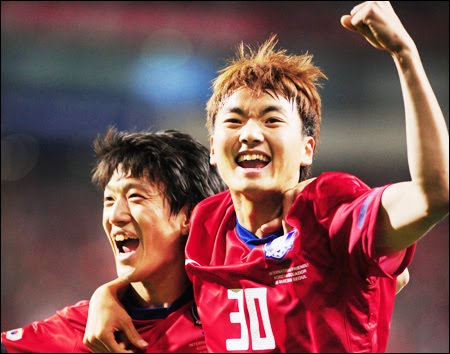 Lee Seung-yeoul, right, celebrates with teammate Lee Chung-yong after scoring a goal during the South Korean national team's friendly game with Ecuador at Seoul's Sangam Stadium, Sunday. South Korea won the match 2-0. / Korea Times
Former 2002 World Cup Korea team boss Guss Hiddink said before that the new national squad would benefit from the combination of experienced and fresh younger members.
On Sunday, the Taeguk Warriors proved the Dutchman was right, as Young guns Lee Seung-yeoul and Lee Chung-yong exploited their presence on the pitch by scoring the goals that lifted South Korea to a 2-0 victory over Ecuador in a friendly at Seoul's Sangam Stadium.
Lee, one of the youngest members of the squad, unleashed a left-footer outside the box to give Korea the lead in the 73rd minute, followed by Lee's brilliant drive six minutes before time.
With the win, South Korea made it even with the Latin Americans, gaining revenge for a 2-1 loss in their first meeting in Houston, the United States, in June 1995.
Under Huh Jung-moo's leadership, South Korea has recorded 20-4-13 since December 2007. Before heading off to Japan on Saturday for a friendly with the Japanese team, he will shortlist the current 30-man squad to 26 members ― three sidelined as contingency additions.
The national team will them have two more tests against Belarus and Spain, before arriving in South Africa on June 5.
Facing the Ecuadorians, Huh Jung-moo, the 47th-ranked team's manager, put veteran Lee Dong-gook instead of an injured Park Chu-young to pair up with the less-experienced Yeom Ki-hun up front. He also placed team captain Park Ji-sung in the starting lineup against expectations the Manchester United star would be rested in the beginning.
Though Yeom and Kim Jae-sung posed threats to the South Americans with their ceaseless moving, Korea in general failed to impress the sell-out audience at Sangam.
 The team's first chance came in the 29th minute with an overlapping Oh Beom-seok cross from the right, which found Yeom, whose shot was met by a fine save by Ecuadorian goalkeeper Marcelo Elizaga.
Then in the 37th, Yeom headed a Lee Dong-gook cross from the right into the woodwork.
Two minutes into the second half, midfielder Ki Sung-yueng's corner barely missed out on Lee Dong-gook's heading effort, and Kwak Tae-hwi's cross from the right in the next minute went wide open.
In the 59th minute, Kim Jae-sung intercepted a pass from Geovanny Nazareno and sent a low cross to the on-rushing Lee Dong-gook, whose sharp drive to the left was barely deflected by an outstretching Elizaga.
Korea also fell for a couple of counterattacks from Ecuador ― Hwang Jae-won's failed clearance could have led to a dangerous moment, right before Kwak managed to make it safe with a tackle. Two minutes later, a long Ulises de la Cruz cross gave Edison Preciado a one-on-one chance up front, but Korean goalie Jung Sung-ryong saved with ease.
Korea's continued attacking finally paid off in the 73th minute, after Yeom sent a reverse-heading pass in front of Lee Seung-yeoul.
Lee, the 21-year-old FC Seoul striker, beat a defending Marcelo Fleitas and shot a left-footed drive into the right corner of the net for his third goal in six A-matches.
The Korean blitz didn't subside and Lee Chung-yong of Bolton Wanderers, who picked up a pass from Kim Bo-kyung, scored the team's second by netting a rebound off Elizaga.
The only thing that might worry the manager Huh came in the last minutes of the game, when Kim Jae-sung was sidelined after Pedro Quinonez brought the lively midfielder down, which earned him a yellow card.
By Yoon Chul
Staff reporter
Credits :Koreatimes
Friday, May 14, 2010
Seoul subway world’s 3rd largest in ridership
 Crew members of Seoul Metro 9 salute guests during an opening ceremony of the new Line 9 of Seoul subway at Gaehwa Station in Seoul on July 24, 2009. The Seoul subway system, which started operations in 1974 with less than 10 kilometers of underground track, is the third largest in the world in terms of ridership now. / Korea Times photo by Oh Dae-geun.
Most foreign visitors to Korea would instantaneously recognize the extensive use of railroads in urban transportation

In the capital city of Seoul, more than 40 percent of commuters use the subway system every day ― the largest share among all modes of transportation.
Also, Seoul's subway system is truly underground. Seventy percent of the routes are subsurface, and the underground spaces are also used for pedestrian walkways, shopping and dining.
The heavy reliance on the subway for urban public transportation is not particularly surprising in Korea, where the population density is one of the highest in the world and more than three-quarters of its land is so mountainous that urban development is virtually impossible.
What is surprising, however, is the fact that its high level of services (clean and quiet trains, a frequent schedule with journeys as short as two minutes, and the dense network reaching many destinations across the metropolitan area) are provided at a relatively modest fare. The current base fare is only about $0.80. While this is more expensive than the basic fares on the Moscow or Mexico City subway systems, it is less than half of those found in most cities in Western Europe and North America. The Seoul subway is not merely an urban transport system for low income citizens, but a lively living space for millions of middle class residents.
The Seoul subway system, which started operations in 1974 with less than 10 km of underground track, is the third largest subway system in the world in terms of ridership now.
Subways were built in other major cities ― Busan, Incheon, Daegu, Daejon and Gwangju. Only the systems in Tokyo and Moscow attract more passengers than the Seoul subway system, although some in Chinese cities will soon become larger. Currently, with the nine main lines featuring 291 stops (and increasing), complemented with several other surface, underground and aboveground railroad lines, the system serves approximately 5.6 million passengers per day. In a city with a population of 10 million (24 million if the surrounding metropolitan areas are included), the subway system is the main artery of urban life in Seoul. Since Korea's system is relatively new and has been continuously upgraded with better technology and management practices, it will serve as a great example for major cities in developing countries that are experiencing a rapid increase in population.
The necessity for the subway system in Seoul was part of public discussion during the rapid industrialization due to the successful economic planning and accompanying urbanization that started in the early 1960s. In 1960, Seoul's population was less than 2.5 million. It swelled to 5.5 million in 1970 and more than 8 million in 1980 due to large scale rural-to-urban migration. As the expansion of the existing roads and the construction of the new arterial roads system could not successfully meet the bulging demand for urban transportation, the citywide subway system was conceived in the late 1960s.

Competition with bus service
The construction of underground rail system was not only extremely costly compared with other transportation infrastructure such as road construction but also technologically challenging. The first line, No. 1, had less than 10 km of underground tracks. The rest of the system relied on the existing rail system run by the state-run Korea Rail Corporation. Political and financial support from central government was essential in order to build the system even though the project mainly benefits local residents, due to the large construction cost. Line No. 1 was met with considerable enthusiasm as the subway became a viable urban transportation alternative. Initially, the construction and operation of the system relied heavily on Japanese technology.
However, the successful technology transfer significantly reduced costs and the time for construction of new routes and stations. While the frequent changes of routes and political wrangling over the financial viability created on-and-off excitement on the expansion of the subway system, the improvement of Korea's technical capability in building subways generated continuous expansion of the system through the 1980s and 1990s.
One of the biggest challenges created by the emerging system was how to handle the competition with the existing bus service. Before the subway was introduced, there already existed an intricate bus network run by many private providers. Although routes were regulated, there was substantial competition among the bus companies. Since each route had a local monopoly of passengers, any adjustments of routes were always contentious and the process could be corrupted easily. More importantly, the fact that the subway was run by the government and buses were run by many private companies made cooperation between the suppliers difficult.
From the perspective of passengers, it would be beneficial to transfer freely across the modes or between buses to complete a trip. Also, rapid transit has the advantage of hauling many passengers over a long distance in a limited corridor, while buses are more economical to provide feeder services to reach more destinations. If each supplier charges separately for their services, there is an incentive for the passenger to stay in one mode in order to save extra fares for transfers. At the same time, knowing this each supplier could provide socially-inefficient-but-ridership-maximizing routes. Consequently, there were duplicate services between suppliers. Even though the subway is operated by a public company, it has to take away passengers from the competing buses in order to be financially viable, rather than cooperating with them in delivering a more efficient combined transportation service.
Free transfer across services
The complicated coordination problem was resolved by region-wide negotiations between the Seoul government, and subway and private bus companies in the early 2000s. In exchange for a guaranteed subsidy, any public transportation service suppliers within the Seoul metropolitan region allow free (or at nominal cost) transfer across services. The bus routes were overhauled, and the free transfer system substantially increased the efficiency of public transportation as a whole and demonstrated an important point that system-wide efficiency can be achieved even though a large part of it is private. If such a cooperative mechanism were in place earlier, the routes of Seoul metro system would have been used more efficiently for long-distance commuting.
The current subway system is operated cooperatively by three entities. The early lines, Line 1 through Line 4, are operated by the Seoul Metro; Line 5 through Line 8, which were opened during the mid-1990s, are operated by the Seoul Metropolitan Rapid Transit Corporation; Line 9, the newest, is owned by Seoul Metro Line 9 Corporation. The first two corporations are public enterprise owned by Seoul Metropolitan Government, while the last one is a for-profit company.
Introduction of private investments
The introduction of private investments in urban infrastructure has been experimented with in Korea to varying degrees of success. In a typical arrangement, a private corporation (often a consortium of large corporations and private investors), is allowed to build social infrastructure and operate it for a fixed number of years (15-30). The operations (such as prices and service levels) are regulated, but the activities are for-profit with a guaranteed minimum profit rate.
As private investment was mobilized to finance infrastructure construction, it reduced the outlay by the government. However, such an arrangement has a serious moral hazard problem. There is a strong incentive for the private participants to overstate the benefits of the project, and end up relying on public support when the actual market demand falls short of the forecast.
A similar arrangement was made for the rapid rail line (AREX) that connects the two major international airports (Incheon and Gimpo), to Seoul Station in the middle of the city (not finished yet). Initially, the line was constructed by a consortium headed by Eukorail, which includes a French company Alstom and Hyundai Rotem (a subsidiary of Hyundai Motor Co.) that manufactures Korean high speed trains. However, as the actual user rate has fallen much shorter than forecast by the planners, Korail has taken over 88% of the company making it virtually a government-owned one.
While AREX trains are designed to run at 120 km/hr, KTX (Korea Train Express) trains run as fast as 350 kilometers per hour. KTX is the high speed rail (HSR) system that connects Seoul to Busan and Mokpo located at the southeastern and southwestern tips of the Korean peninsula (about a little bit over 400 kilometers from Seoul). Although road transportation using private cars and express buses are still more widely used in inter-city passenger transportation, the KTX is getting more popular over time. In particular, it has nearly replaced air transportation on those domestic routes.
The primary railroad network in Korea was developed during the 1910-1945 Japanese colonial occupation. During the period of industrialization, gradual improvements were made to the system ― diesel and electric locomotives, double tracks and improved signaling were introduced. When demand for fast inter-city travel increased with economic development, it was first absorbed by the domestic airline industry, as the old tracks were not designed to accommodate modern high speed trains.
Planning and construction of a new high speed rail system (HSR) started during the early 1990s. As the country lacked the technical expertise to develop its own HSR, an international bidding war for the general contractor was opened, and the French system of TGV was chosen (see Box 2). In 2004, after 12 years of construction, some portion of the KTX started operation. If the Seoul-Busan line is completed with a new set of tracks in late 2010, the travel time will be reduced to 2 hours 18 minutes from 4 hours 10 minutes on conventional trains. The adaptation and expansion of the KTX will put all of South Korea within effective daily commuting distance, promoting business activities between major cities.
Technology transfer
In the evaluation of the initial adoption of foreign technology for the HSR in the early 1990s, the opportunity for technology transfer was one of the most important considerations. As there were only a few countries that possessed the technology (Japan, Germany, France, and Italy) then, they were not eager to share their knowhow of the cutting-edge technology. The first train, the KTX-1 was based on the French company, Alstom's TGV Reseau to accommodate the mountainous terrain of Korea.
In 2004, South Korea became the seventh country after Spain and China to develop independently HSR technology by successfully test-running the new HSR-350x train that was designed to run at 350 kilometers per hour.
The prototype is now in the production as the KTX-II. While other countries currently possess more advanced HSR technologies, Korea's success in developing independent HSR trains enables it to manufacture the KTX-II domestically without any royalty payments and technology transfer limitations, thereby creating employment and technical expertise for future exports.
This is the result of a successful public-private partnership in the G7 Project comprising the Korea Railroad Research Institute, the Korea Institute of Industrial Technology and Hyundai Rotem. While the majority of the project's research and design was supported by the government through the two research institutes.
The technology was transferred to private companies for a fee. As private companies are reluctant to face the uncertainty of the development of new technologies with massive investment, the government took the risk for initial development. On the other hand, private companies are able to exploit the new technology for economic gain better than government.
Mega Asian cities embrace subway systems
The Seoul metro system, which started operation in 1974, is relatively new compared with other major cities in the world. London, the first city that adopted underground railroads for urban transportation, started operations in 1963.
However, the popularity of subways started with the availability of electric trains in 1890. Paris started its first subway operations in 1900, followed by New York City in 1904. In Asia, Tokyo was the first city that built a subway. Currently, the Tokyo subway system has the largest ridership in the world. Recently, major Chinese cities have adopted subways as the most important urban transportation system.
In 2020, the Shanghai system is expected to become the largest in the world with 22 lines and being 877 kilometers in length. The Beijing system is expected to expand to 19 lines and 561 kilometers of track by 2015.
Who is Kim Sun-woong?

The writer is a professor of economics at the University of Wisconsin, Milwaukee. He also taught at Bryn Mawr College, the University of Pennsylvania, Justus-Liebig University of Giessen (Germany), Ajou University (Korea), and KDI School of Public Policy and Management in Korea.
He received an MA on urban planning from Harvard and a Ph.D. in economics from MIT. His current research interests include the economics of education, urban and real estate economics, and labor and political economics.
He has published over 50 articles in well known professional journals on economics, political science and urban studies. He is the president of the Korea-America Economic Association and the co-editor of the International Economics Journal. He can be reached at kim@uwm.edu
By Kim Sun-woong
Professor at University of Wisconsin
Credits : KoreaTimes,KoreaNet
Celebrate Buddha’s birthday with lotus lanterns
 Brightly lit lotus lanters hang at Jogye Temple. This year Buddha's Birthday falls on May 21, and the Buddhist circle is making various activities along with the annual Lotus Lantern Festival.
There is a Buddhist saying that goes: ``Please attain Buddhism in your next lifetime by lighting a lantern in this life.'' The saying is being realized by many Buddhists this May, as they visit temples scattered around the country to light lotus lanterns and celebrate Buddha's Birthday.
``It's hard for me to light lanterns every day, although I would love to. Buddha's Birthday is one of those days when I just have to put everything aside and light up a colorful lantern for the well-being of my friends and family,'' Yoon Myung-sook, a 52-year-old housewife who visited Bongeun Temple in Samseong-dong, said.
Buddha's Birthday is celebrated annually on the eighth day of the fourth lunar month ― May 21 this year ― and the Jogye Order of Korean Buddhism is gearing up for its annual Lotus Lantern Festival, or the ``Yeondeunghoe.''
``Within the Buddhist religion, Buddha's Birthday is the biggest holiday among other events. We always had lotus lantern events throughout history and it's a time when you get to learn and appreciate Buddha and his teachings. It's a time to stand back and really embrace his lessons,'' Ven. Jong Min, deputy director of the Department of General Affairs at the Celebration Committee for Buddha's Birthday, told The Korea Times.
``It has also become an event where numerous foreigners participate, further bringing Korean Buddhism to an international level,'' he said.
Events

The Lotus Lantern Festival has become bigger, with more exciting events and performances visitors can enjoy, including parades, exhibitions and activity booths.
May 14 to 23
Bongeun Temple, located in Samseong-dong, is one of the most famous temples in Seoul. Located in the heart of the city, it offers a tranquil atmosphere amid the busy streets full of cars and numerous skyscrapers. To celebrate Buddha's Birthday, the temple is holding a special exhibition of traditional lanterns. Take a break from the hustle and bustle of the day, and enjoy both large and small, colorful lanterns made by devoted Buddhists. Bongeun Temple is located near exit 6 of Samseong Station on subway line 2. For more information, visit www.bongeunsa.org.
Another way to enjoy lanterns is by visiting Cheonggyecheon, or Cheonggye Stream. The narrow stream will be decorated with numerous lanterns, creating a dream-like atmosphere with colorful lights shining brightly in the dark. Large lanterns will be placed on several platforms in the middle of the stream, perfect to take photos with or simply walk, observe and appreciate lights.
May 15
The Festival's Eve Celebration will take place in the Insa-dong area, near the Jogye Temple, on May 15. The street near the temple will be lit with colorful lanterns, and exciting stage performances, parades and other interesting events will add to the festivity. The parades and events will start from 7 p.m. to 9 p.m. Get a quick preview of the festival at the Eve Celebration near Jonggak Station on subway line 1 and Anguk Station on line 3.
May 16
Buddhist Street Festival
The following day will be interesting for both believers and non-believers. The Buddhist Street Festival will take place on the street in front of Jogye Temple. The whole street will be full of interesting and educational booths set up by Buddhists, the festival committee and also foreigners who wish to share their own unique culture with visitors.
Last year, the street was full of people wishing to participate. Visitors walked freely along the streets, poking their heads into the booths, some staying to learn various activities, including Buddhist art, making lotus lanterns and trying out temple food, while others walked along the some 100 booths to feel the gist of the festival. This year is expected to be similar, yet better.
Some booths will observe religious rituals, giving visitors a moment to take photos and try on costumes themselves to feel the spirit of Buddhism. Other booths organized by a number of Buddhist countries, such as Tibet, Thailand and Cambodia, will offer their distinctive Buddhist culture they practice in their home countries, from clothes and folk games to food. Check out the festival guide booklet beforehand, as it could be overwhelming to try out everything.
On the same day, organizers will build a large stage where various traditional performances will take place. Korean folk performers, Lotus Lantern Festival performance groups and International Buddhist communities will put on an eye-catching shows to further escalate the festivity. The street festival and performances will start from noon to 7 p.m.
For those who want to experience a more formal and educational performance, visit Dongguk University Stadium at 4:30 p.m. on the same day for the Buddhist Cheer Rally or ``Hwahap Hanmadang.'' A traditional Buddhist ritual called the ``Beopyusik'' will be underway to celebrate Buddha's birthday, along with the lightings of numerous lanterns.
Lantern Parade
The main event of the festival is the Lantern Parade, where more than 100,000 lanterns will create an ocean of lights.
``In China, there are parades where designated people hold large lanterns, walk around and spectators enjoy the parade. The Korean Lotus Lantern Festival is different because it allows everybody to enjoy. The participants make their own small lanterns and are more than welcome to walk along the parade,'' said Park Sang-hee, team leader of the Celebration Committee for Buddha's Birthday.
In order to create prettier and more durable lanterns, the festival committee held seminars and worked with various materials over the past year. According to Park, the lanterns in the past were simpler in shape, but they tend to get more colorful and fancier year after year.
Larger and fancier lanterns depicting Buddha, lotus flowers and various animals will also be on floats along with the small ones.
The parade will start travel Dongdaemun to Jogye Temple along Jongno Street from 7 p.m. to 9:30 p.m.
From 9:30 p.m. to 11 p.m., visitors, festival organizers and performers can all get together to enjoy the ``Hoehyang Hanmadang,'' or the Closing Ceremony, at Jonggak Intersection.
Dance, sing and take photos with friends, families and other visitors as the Lotus Lantern Festival finally comes to an end, promising a much better year next year.
English, Chinese and Japanese interpreters will be present throughout the event. For more information, visit www.llf.or.kr or call (02) 2011-1744.
The lotus lantern custom goes a long way back in history. For Korea, the oldest records regarding the lanterns are from the Silla Kingdom (B.C. 57-935 A.D.). The lotus blossom represents purity and Buddha, and so it has been depicted in many paintings, decorations and sculptures over the years.
Unlike other flowers, the lotus normally blossom in dirty swamps and lakes. No matter how dirty the water and surroundings may be, the blossom remains clean. This feature of the flower allowed Buddhists to believe that Buddha himself was like a lotus.
Credits:Koreatimes
'Clinton to visit Seoul over naval tragedy'

By Lee Tae-hoon
Staff reporter
U.S. Secretary of State Hillary Clinton will visit Seoul later this month to discuss diplomatic coordination between Seoul and Washington over the sinking of the South Korean Navy frigate Cheonan on March 26, sources said Friday.
Clinton's visit will likely take place after her scheduled trip to Beijing from May 24 to 25 for a "strategic and economic" dialogue, Yonhap News Agency reported.
Clinton was reportedly considering including Japan on her itinerary.
"We're still looking at other stops in conjunction with her trip to China next week, but obviously, we should finalize those details soon," Assistant Secretary of State Philip Crowley said Wednesday.
However, both the Ministry of Foreign Affairs and Trade and the U.S. Embassy in Seoul told The Korea Times that they had yet to be informed of any visit to Seoul.
Clinton's trip to South Korea, if realized, will come shortly after a multinational team announces the result of its investigation into the naval incident around May 20.
Earlier this week, Clinton called Chinese State Councilor Dai Bingguo to discuss the "ongoing investigation and its potential ramifications once the investigation is completed."
Investigators, including experts from the United States, Britain, Australia and Sweden, have tentatively concluded that a torpedo fired from a submarine was the cause of the sinking.
Seoul and Washington have not named North Korea as the culprit in the disaster, which took the lives of 46 sailors.
However, they have agreed not to resume the stalled six-party talks until after the cause is determined, and to begin discussing possible responses if Pyongyang is found responsible.
They have recently held discussions on North Korea and other bilateral and regional security issues, such as the transfer of wartime operational control from the U.S. to South Korea, according to sources.
James Steinberg, U.S. deputy secretary of state, supported Seoul's position Monday, saying the incident "will have an impact on how we proceed in dealing with the challenge of North Korea and its actions, not only on the nuclear front, but in other provocative measures that it takes."
Any resolution against North Korea must be approved by China, North Korea's staunchest communist ally and one of five veto powers on the U.N. Security Council, along with the U.S., Russia, Britain and France.
Credits: Koreatimes
Offshore processing worth billions to Northern Territory

ENERGY giant Woodside has told Northern Territory leaders its off-shore gas processing platform will lead to billions of dollars of investment in Darwin.
And Woodside boss Don Voelte has issued a subtle threat to East Timor if the tiny nation tries to pull out of a multibillion-dollar international agreement.
East Timor was competing with Darwin to process the LNG from the Greater Sunrise field - but Woodside decided on a cheaper third option to build an experimental floating platform.
East Timor Prime Minister Xanana Gusmo has threatened to sink the entire development in response.
But Woodside chief executive Don Voelte said East Timor could not legally back out of the deal.
"They cannot walk away from it."
Mr Voelte said the developing country would be breaking a treaty it signed two and a half years ago - which would hurt its ability to deal with the United States, the European Union or any other international body.
"It will do them a lot of damage ... But we'll win it on the merits of the program." he said.
Mr Voelte said the floating platform would offer billions of dollars worth of construction to businesses in Darwin and Dili.
He said it would be a "country building" project for East Timor and would lead to billions of dollars of investment in Darwin.
"So here you have a project which is going to be billions and billions and billions of dollars and the nearest and closest existing (industry) capable of handling that is right here in Darwin," he said.
Chief Minister Paul Henderson discussed opportunities for the Territory's involvement in the project with Mr Voelte last week.
Woodside was unable to make any concrete offers, but promised there would be "significant" economic and job opportunities.
Mr Henderson said he was not concerned that off-shore processing facilities could hurt the Territory's economy in the future.
"I am a realist. I have to be as realist as the Chief Minister. Like King Canute couldn't hold back the tide, we are going to see more of these remote fields processed offshore. That's the reality of where the technology is heading," he said.
Floating processing facilities could be used to develop smaller fields north of Darwin that were not financially viable previously.
Credits :ntnews.com.au
Thursday, May 13, 2010
Spring time in korea
People often hear about Korea's four distinct seasons. Right now, we're in the middle of Spring, and it's absolutely beautiful. So I went over to our favorite park, Bucheon Jung Ang Park,Cheonan Park, ect . took Spudgy out with me,the flowers are now in full-bloom, people are heading outside more, and random dance battles are occurring in the parks.
 Cheonan park

Soraksan


 Cheonan park

Soraksan


Name in Korean calligraphy
During the Arabian Travel Market 2010, the Korean center at the Dubai International Convention & Exhibition Center was buzzing like a beehive. At the booth, visitors could receive their names written in Hangeul (the Korean alphabet) using a brush and ink in a traditional calligraphic style, and have their photo taken with Korean people in Hanbok (traditional dress).


The International Archival Culture Exhibition 2010
The International Archival Culture Exhibition 2010 will exhibit selected treasures of the UNESCO’s Memory of the World and Records Management Systems, and also the cutting-edge records management technology around the world.
- Period : June 1 – 6, 2010
- Venue : COEX A Hall, National Archives - Nara Repository
- Theme : A World Re-discovered in Archives
http://www.iace.or.kr/eng/main.html
- Period : June 1 – 6, 2010
- Venue : COEX A Hall, National Archives - Nara Repository
- Theme : A World Re-discovered in Archives
http://www.iace.or.kr/eng/main.html
World Friends Korea

President Lee Myung-bak, fourth from left, makes a fist with volunteers during a ceremony at Cheong Wa Dae, Thursday, to inaugurate World Friends Korea, the country’s version of the Peace Corps in the United States, launched in 1961 to promote peace and friendship worldwide. At center is first lady Kim Yoon-ok
The government launched a group of volunteers Thursday to strengthen its goodwill activities in underdeveloped or developing countries around the world in an effort to become a more responsible member of the international community.
The group, named World Friends Korea, is the country's version of the Peace Corps in the United States, launched in 1961 to promote peace and friendship worldwide, officials here said.
About 2,000 volunteers belong to the Korean body, but the membership will grow to over 3,000 by the end of the year, according to a spokesman from the Presidential Council on Nation Branding. Currently, the U.S. is the only country that sends more than 3,000 volunteers abroad annually. Today is a remarkable day for Korea's peace missions abroad. You are seeds of hope and friendship,'' President Lee Myung-bak said during the inauguration ceremony at Cheong Wa Dae. ``There are many countries out there that need your services. Your contribution will help improve Korea's global reputation. You are civilians, but should act like diplomats.''
 Chairman Euh Yoon-dae of the Presidential Council on Nation Branding(PCNB)hoped such efforts will help Korea become a respected and beloved nation.
 The participants from KOICA(Mr.Azevedo Marcal-East Timor) and from WSK(Mr.Jaimito Neves ;)-East Timor)

 The Participants from WSK's(World students in Korea 1st batch & 2nd batch) second from left(That's me ;))


 The red color,,that's me ㅋㅋㅋ


In a congratulatory message, U.N. Secretary General Ban Ki-moon, a former South Korean foreign minister, also urged Korea to send more volunteers around the globe and increase its role on the global stage.
The volunteers will work with governments, schools, non-profit organizations and businessmen in various areas, including education, the environment, agriculture and information technology. They will also play an important role in promoting Korea's culture and food around the world, officials said.
``You can call the World Friends Korea the unified brand of the country's overseas volunteer activities,'' Euh recently told The Korea Times. So far, Government agencies have had their own volunteer programs in foreign countries, but from now on they will work together under a shared goal. My council will help coordinate their activities.''
The group will include some 300 volunteers who belong to the Korea International Cooperation Agency under the Ministry of Foreign Affairs and Trade, the Ministry of Public Administration and Security and the Ministry of Education, Science and Technology.
In addition to the government-run volunteer programs, those run by religious and civic groups will also get full support from the administration, officials said.
The expansion of overseas volunteering is one of the 10 goals the presidential branding council adopted to upgrade the nation's global image. The council was created on instructions from President Lee.
Policymakers here have complained that Korea, associated with the negative image of North Korea and corruption scandals involving politicians and businessmen, doesn't get its due treatment from overseas buyers as the world's 13th largest economy.
The council's other projects include promoting taekwondo and Korean food and language; strengthening global marketing for leading small firms; raising economic contributions to underdeveloped countries; introducing foreigner-friendly policies; and establishing database and communication channels for seven million Koreans living abroad.
Services in Korean :
http://news.naver.com/main/read.nhn?mode=LSD&mid=sec&sid1=123&oid=154&aid=0000001717
Subscribe to:
Posts (Atom)